








Medical & Clinical XR Solutions XR Training & Visualization Case Study
A walkthrough of immersive surgical training, clinical guidance, and patient-visualization solutions built for hospitals, medical device teams, and healthcare training programs.
![Medical & <span class='text-[#FF4400]'>Clinical XR Solutions</span> XR Training & Visualization Case Study](/_astro/medical-solutions-bg.C75k289a_ZeOTBr.webp)
Challenges & How These Services Help
This offering covers immersive training and visualization solutions for hospitals, medical device teams, and healthcare training programs built on Unity for consistent core logic across VR, AR, MR, and connected monitoring dashboards. The aim in every engagement is to let clinical teams rehearse high-stakes procedures safely, repeatably, and under real situational pressure before they count with an actual patient.
Solutions span five connected pillars, VR procedural simulation, AR device guidance, MR anatomy visualization, live vitals-linked scenarios, and gamified competency tracking and are combined per engagement to fit a hospital's procedures, device catalogue, and training program.
Limited, high-stakes OR repetitions
Trainee surgeons get only a handful of supervised real cases to learn a new procedure solved with VR simulation that lets them repeat the full procedure as many times as needed with zero patient risk.
New device and implant learning curve
Reps and clinicians have to get an unfamiliar instrument set right the first time solved with AR-guided overlays that walk them through the physical kit step by step.
Hard-to-visualize patient anatomy
2D scans and textbook diagrams don't convey real 3D spatial relationships solved with MR visualization that turns a patient's own imaging into a life-size, hands-free 3D model.
No physiological feedback in training
Standard training scenarios rarely show the consequence of a wrong step solved with a live vitals monitor that responds in real time to the trainee's decisions.
Low completion in mandatory CME
Static online modules see poor engagement and last-minute cramming solved with gamified competency paths that tie progress to certification credit and a cohort leaderboard.
Product Context
Primary users
Surgeons and surgical residents, nursing and OR staff, medical device reps and trainers, radiology/anatomy educators, and hospital simulation center or L&D teams.
Core problem
Clinical teams need a safe, repeatable, and measurable way to train on procedures and new devices without added risk to patients or reliance on scarce OR time.
Platform
Cross-device XR builds (VR headset, AR tablet/phone, MR headset) built on Unity, with support for DICOM-derived 3D anatomy and connected vitals/monitor data where the engagement calls for it.
Solution Architecture
Five connected pillars, deployed individually or combined into a full simulation-and-training program for a hospital or device line.
VR Surgical & Procedural Simulation Training
Two related uses of the same virtual environment. The full version is a step-by-step surgical walkthrough in a virtual operating theater, built from a case's imaging and implant data, for rehearsing an entire procedure. A lighter version is device-focused: a standalone VR session for exploring a new implant or instrument, seeing how it's assembled and used without running the full case. Since a VR headset fully replaces the real-world view rather than overlaying it, everything the trainee sees, including tools, references, and vitals, is part of the simulated scene, not a live feed from an actual OR.
- Two modes from one build: full procedural rehearsal or a standalone device/implant walkthrough
- Step-by-step procedural sequencing with real-time progress tracking
- In-scene vitals panel that reacts to the trainee's decisions, adding situational pressure
- Repeatable, zero-risk practice ahead of real OR time or certification
AR Guided Procedures & Device Training
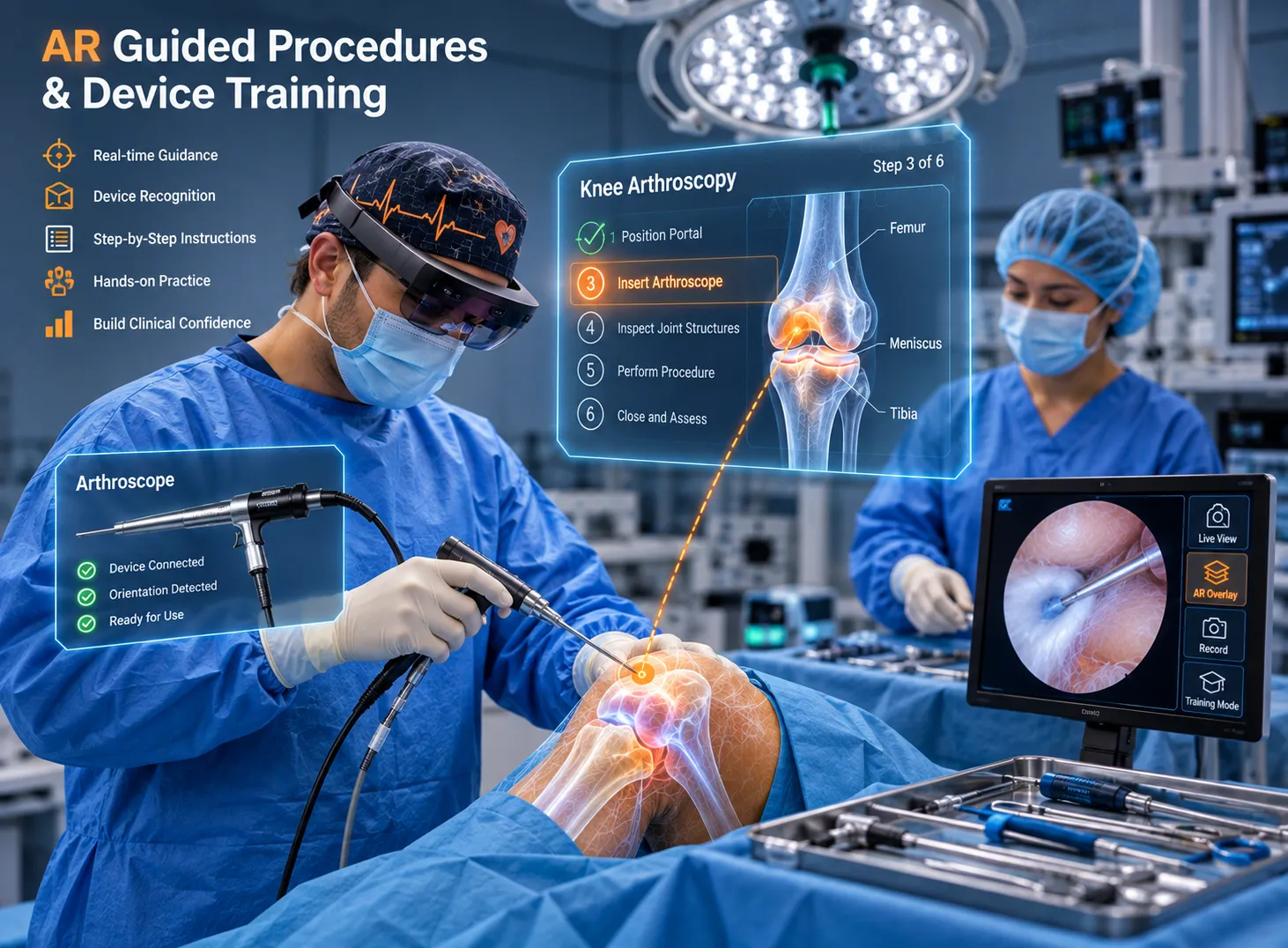
Tablet- and phone-based AR that overlays step-by-step guidance directly onto a physical model, mannequin, or an actual device kit built for device reps training clinicians on a new implant or instrument set, or for bedside procedure checklists where a full headset isn't practical. The same session can be shared live, so a remote specialist or device rep sees exactly what the on-site clinician sees and can talk them through the step in real time telementoring without anyone needing to travel in.
- Marker-based tracking locked to instrument trays or model anatomy
- Live telementoring: a remote specialist or device rep joins the on-site AR view to guide the procedure in real time
- Step-by-step call-outs synced to the physical device kit
- Runs on existing tablets and phones; no dedicated headset required
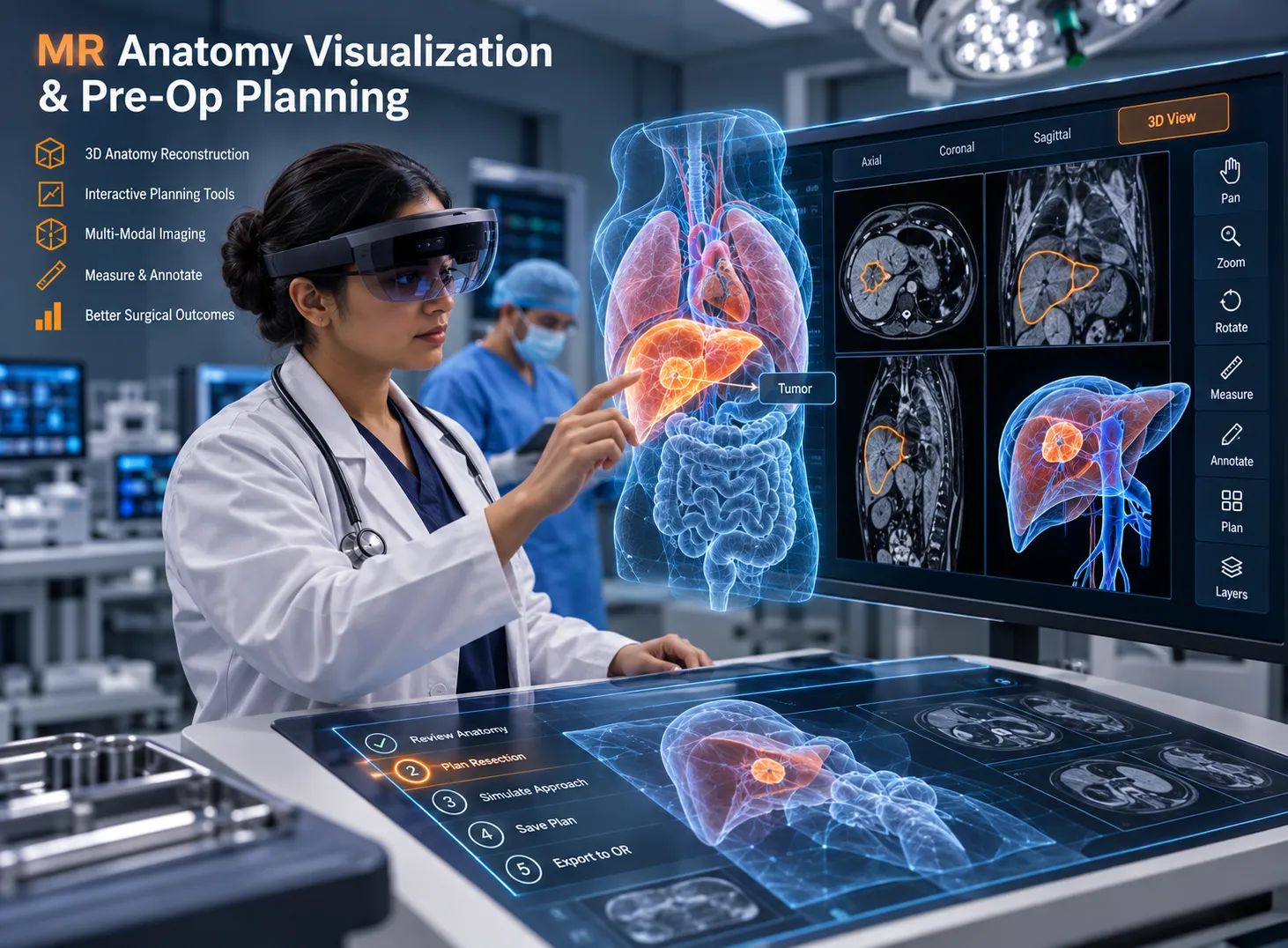
MR Anatomy Visualization & Pre-Op Planning
Mixed-reality headsets turn a patient's own scan data into a life-size 3D model that floats in the room; hands stay free to rotate, slice, and annotate the anatomy directly, supporting resident teaching, pre-op planning, and patient consent conversations.
- DICOM-derived 3D models built from a patient's own CT/MRI data
- Hands-free manipulation: rotate, slice, and measure in place
- Shareable views for resident teaching and patient consultations
Real-Time Vitals & Scenario Monitoring
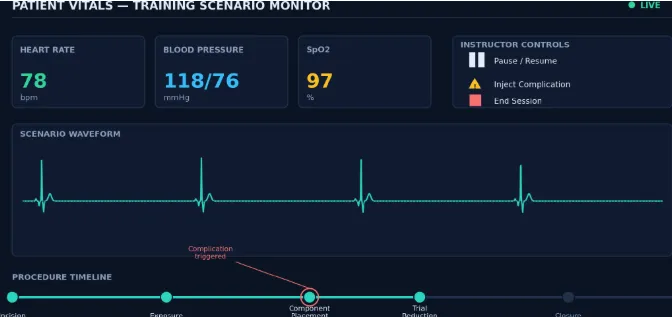
A live monitor view that mirrors a real bedside station heart rate, blood pressure, and SpO2 responds to the trainee's actions in the simulation, so a wrong step has a visible physiological consequence instead of just a red X on a checklist.
- Scenario-linked vitals that respond to trainee decisions in real time
- Instructor view for pausing, branching, or injecting complications
- Session logs for structured debrief after each run
Gamified Clinical Training & CME
Procedural competency is reframed as a progress path: modules unlock as a resident advances, completions count toward certification credit, and a cohort leaderboard turns mandatory CME into something residents actually want to finish.
- Stage-based competency map replacing static CME modules
- Scored assessments tied to certification / CME credit tracking
- Leaderboards and badges to drive completion across a cohort
VR Surgical & Procedural Simulation Training
Real-Time Vitals & Scenario Monitoring
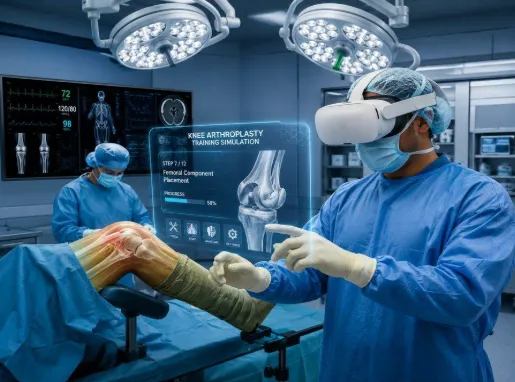
Case Example: Knee Arthroplasty Training Simulation
The VR module above puts a trainee mid-procedure at step 7 of 12 femoral component placement, 58% through the case. An in-scene panel offers tools, X-ray, anatomy, and settings shortcuts alongside an isolated 3D view of the femoral component and joint, positioned next to the annotated limb. In the background, a simulated patient monitor tracks heart rate, blood pressure, and SpO2 the same way a real one would giving the trainee the full procedural and situational pressure of an actual case, with zero risk to a real patient.
Summary
These five pillars work as one connected training system: VR gives trainees unlimited, zero-risk repetitions of a full procedure, AR carries new-device guidance to the bedside or training room, MR turns a patient's own scans into something residents can study in 3D, live vitals link decisions to consequences, and gamified competency tracking keeps mandatory training measurable and worth finishing. Engagements typically start with one procedure or device line and expand as the underlying platform is reused across a hospital's training program.
![<span class='text-[#FF5214]'>Summary</span>](/_astro/handshake.C1r0Q7Fg_Z275FzV.webp)

Vervelo is a digital-health software partner blending deep clinical insight with world-class engineering to build tailored, secure, interoperable healthcare platforms.
Benefits of custom software solutions
-

You fully own IT consulting and software delivered
-

You get a highly personalized solution
-

Customize and integrate seamlessly
-

On-demand scalability is always possible

Frequently Asked
Questions
Have a question that needs a human to answer? No problem.
Speak to our sales team now → Can you create animated product or industrial demonstrations?
Yes. We can create animations that demonstrate product functionality, machine operations, assembly processes, workflows, and technical concepts in an easy-to-understand visual format.
Can you create a prototype or MVP before full development?
Yes. We can develop a prototype or Minimum Viable Product (MVP) to validate the core concept, gameplay mechanics, technical feasibility, and user experience before moving into full-scale production.
Do you provide 3D modeling services?
Yes. We create 3D models for characters, environments, props, vehicles, products, and other assets based on the project's visual and technical requirements.
Do you provide support after the project is released?
Yes. We can provide post-launch support, maintenance, bug fixes, platform updates, SDK upgrades, performance improvements, and additional feature development based on the project's needs.
Can you take over a partially completed game project?
Yes. We can review an existing or partially completed project, understand its current state, identify technical issues and pending features, and continue development based on the agreed scope.
Who owns the source code and project files after development?
Project ownership and source-code delivery are defined in the project agreement. For client-owned projects, the agreed source code, assets, and project files are handed over according to the contract.