








Industrial VR / AR / MR Solutions XR Product & Training Case Study
A walkthrough of immersive training, guided operations, and real-time monitoring solutions built for manufacturing and process industries.
![Industrial <span class='text-[#FF4400]'>VR / AR / MR Solutions</span> XR Product & Training Case Study](/_astro/industrial-solutions-bg.7nFhDWRx_EUgJ2.webp)
Challenges & How These Services Help
This offering covers end-to-end immersive solutions for industrial and manufacturing teams - built on Unity for consistent core logic across VR, AR, MR, and desktop/browser dashboards. The goal in every engagement is the same: let operators, technicians, and engineers learn, work, and monitor complex machinery safely, consistently, and without stopping the production line.
Solutions span five connected pillars - VR simulation training, AR guided operations, MR assisted maintenance, digital twin monitoring, and gamified learning - and are combined per project to fit a client's equipment, workforce, and floor constraints.
Costly, risky on-the-job training
new operators learning directly on live production lines risk safety incidents, scrap, and downtime - solved with VR simulation modules that replicate machine operation step-by-step in a safe, repeatable virtual environment.
Tribal knowledge tied to a few experts
complex machine setup and maintenance know-how often lives with a handful of senior staff - solved with AR guided work instructions that overlay step-by-step visual cues directly onto the physical machine.
Downtime during servicing
Diagnosing internal faults usually means partial disassembly - solved with MR exploded-view visualizations that let technicians inspect internal components in 3D space without opening the machine.
No unified view of floor performance
plant data is scattered across PLCs, spreadsheets, and machine-side screens - solved with a digital twin dashboard that mirrors the physical line and surfaces live health and performance data in one view.
Low engagement in standard training
Static manuals and slide decks see poor retention - solved with gamified training paths that turn procedural steps into interactive, scored simulations with progress tracking.
Product Context
Primary users
Machine operators, process technicians, quality inspectors, plant engineers, maintenance crews, and L&D / training teams.
Core problem
Industrial teams need a safe, repeatable, and engaging way to train on, operate, and monitor complex machinery without stopping production or risking safety.
Platform
Cross-device XR builds (VR headset, AR mobile/tablet, MR headset) paired with browser/desktop dashboards, sharing a common Unity-built core across form factors.
Solution Architecture
Five connected pillars, deployed individually or combined into a single training-and-monitoring program for a client's line.
VR Simulation Training
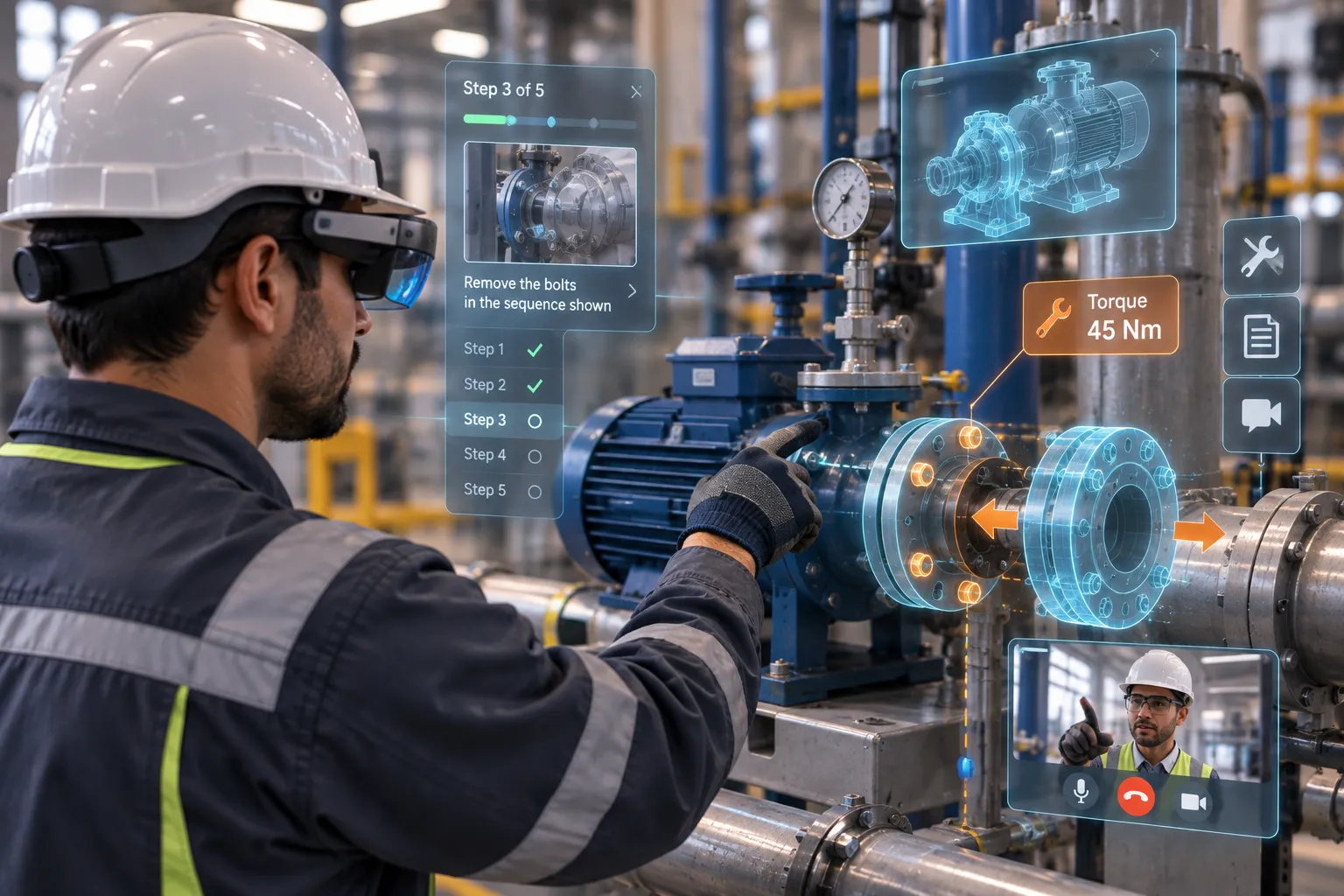
Full machine-operation walkthroughs in a virtual replica of the real equipment. Trainees use motion controllers to interact with a step-by-step guided sequence - a heads-up checklist tracks completed steps while the next required action is highlighted directly on the 3D machine model.
- Controller-driven interaction with 1:1 scaled machine models
- Step checklist with real-time progress and error correction
- Repeatable, risk-free practice ahead of live-line certification
AR Guided Operations
Tablet- and phone-based AR that overlays labeled component breakdowns and live data directly on top of the physical asset - useful for showroom walkthroughs, technician onboarding, and remote inspection where a full headset isn't practical. The same session can be shared live, so a remote expert sees exactly what the on-site technician sees and can coach them through the task in real time a co-working style alternative to flying someone in.
- Marker-based or markerless tracking depending on the environment
- Multi-user sessions, a remote expert joins a trainee’s live AR view to coach in real time
- Tap-to-expand component call-outs with spec sheets or media
- Works on existing tablets and phones - no dedicated headset required
MR Assisted Maintenance
Mixed-reality headsets keep both hands free while an exploded-view overlay sits directly on the real machine - technicians point at a component to see it isolated, rotated, and reassembled step-by-step, without powering down or opening the housing.
- Spatially anchored overlays that stay locked to the machine
- Hands-free operation for technicians working with tools
- Reference panel synced to whichever component is highlighted
Digital Twin Monitoring
A live 3D mirror of the production line, fed by machine and sensor data, so engineers can watch line status, thermal/vibration trends, and throughput from a desk - spotting drift before it becomes downtime.
- Live data binding from PLCs / sensors into the 3D scene
- Per-station health indicators and historical trend charts
- Remote visibility for engineers off the floor
Gamified Training & Assessment
Procedural training reframed as a progress path - modules unlock as stages on a map, completions earn badges, and a leaderboard drives friendly competition across a cohort. The same mechanics used for consumer gamification apply directly to workforce upskilling.
- Stage-based progress map replacing linear slide decks
- Scored assessments with instant feedback
- Leaderboards and badges to drive completion rates
Case Example: Interactive Machine Walkthrough
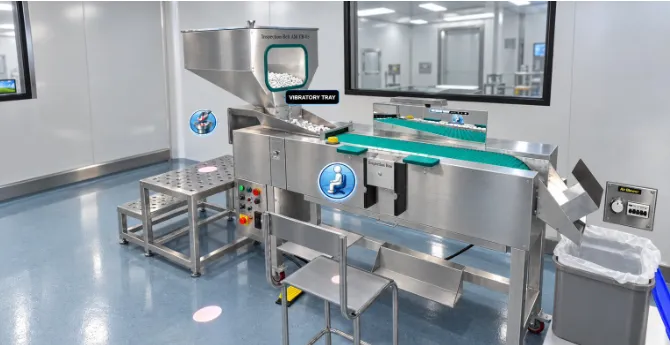
A packaging-line inspection station, shown first as the physical asset and then as the interactive walkthrough built from it - annotated hotspots replace a paper SOP, guiding an operator through setup, the vibratory tray, and the inspection box in sequence.
Summary
These five pillars are best understood as one connected system: VR builds operator competence before anyone touches the real machine, AR and MR carry that guidance onto the physical floor during setup and maintenance, a digital twin keeps the whole line visible in real time, and gamified assessment keeps training measurable and engaging. Engagements typically start with one pillar tied to a specific pain point and expand as the underlying Unity-based platform is reused across the rest.
![<span class='text-[#FF5214]'>Summary</span>](/_astro/vr-simulation-training.D8xAOHfv_Z1sPtnK.webp)

Vervelo is a digital-health software partner blending deep clinical insight with world-class engineering to build tailored, secure, interoperable healthcare platforms.
Benefits of custom software solutions
-

You fully own IT consulting and software delivered
-

You get a highly personalized solution
-

Customize and integrate seamlessly
-

On-demand scalability is always possible

Frequently Asked
Questions
Have a question that needs a human to answer? No problem.
Speak to our sales team now → Which VR platforms do you support?
We develop VR applications for platforms such as Meta Quest and PC VR. Platform selection depends on the requirements, hardware, performance targets, and deployment environment of the project.
How long does it take to develop a game?
Development time varies depending on the size and complexity of the project. A simple prototype may take a few weeks, while a complete production-ready game can take several months. We provide a development timeline after reviewing the requirements.
How do I get a quote for my project?
Share your project idea, target platforms, required features, references, and any existing documentation or project files. We can review the requirements and discuss the scope, estimated timeline, and development cost.
Which game engines do you work with?
We primarily work with Unity and Unreal Engine, selecting the technology based on the project's platform, performance requirements, features, and overall scope.
Can you take over a partially completed game project?
Yes. We can review an existing or partially completed project, understand its current state, identify technical issues and pending features, and continue development based on the agreed scope.
Can you create 3D environments for games and VR applications?
Yes. We create immersive 3D environments for games, VR training, simulations, product experiences, and other real-time applications while considering both visual quality and performance.